Good Nurses Say Bad Words Skeleton SVG: Embroidery Review
I’ve spent years testing digital design assets specifically for embroidery projects, and I always look for one thing: will this artwork actually translate into a stitchable product that people want to buy or gift? The Good Nurses Say Bad Words Skeleton SVG immediately caught my eye because it blends humor, a bold skeleton graphic, and a quote that resonates with a very specific audience. As a designer who regularly digitizes for custom apparel, tote bags, and handmade gifts, I’ve learned to separate a pretty screen graphic from a design that holds up under real thread pressure. This review is based on putting the file through my own mental checklist before ever hooping fabric.
Recently, I was preparing a batch of custom embroidered canvas tote bags for a local nurse appreciation event. The organizer wanted something cheeky yet professional enough to hand out at a hospital. I pulled up the Good Nurses Say Bad Words Skeleton SVG and started evaluating its potential for a clean, repeatable stitch-out. This is exactly the kind of scenario where a digital design file needs to work hard—it’s not just a one-off, it’s the centerpiece of a small-batch production run. My first job was to picture how the skeleton, the lettering, and the overall layout would behave once I converted it into a machine embroidery design.
First Glance: The Skeleton’s Personality and Layout
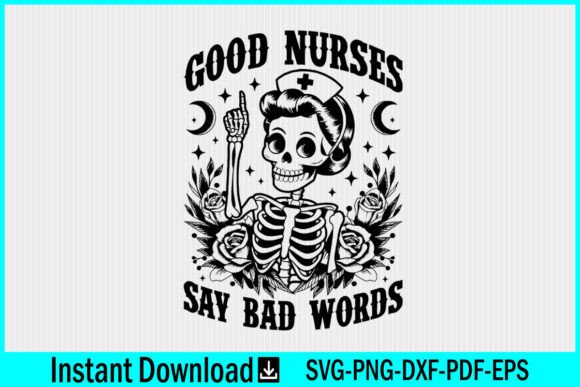
What hit me right away is the unapologetic personality of this design. The skeleton isn’t a clinical anatomical drawing; it’s a stylized, slightly rugged character that looks like it belongs on a worn-in sweatshirt or a vintage-style patch. The bone structure is simplified enough to digitize without losing the sense of movement, and the ribcage and skull have enough detail to feel substantial without turning into a dense nightmare of stitches. The quote arched above it, “Good Nurses Say Bad Words,” is set in a bold, straightforward typography that I can already see working well as a satin stitch or a clean running stitch outline.
The mood is playful, irreverent, and real—exactly the kind of thing a nurse would laugh at after a long shift. The skeleton’s posture even has a hint of swagger, which makes the design feel alive. In terms of composition, the central stacked layout (skeleton figure with text above and below or around) is a designer’s gift for embroidery. It balances well on a left chest placement, a full-front sweatshirt, or a centered tote bag panel. The proportions aren’t too wide, so it won’t distort awkwardly on curved surfaces like caps, though I’d still test it on a structured hat before committing to a run.
Where This Design Truly Shines in Embroidery
After studying the file, I can confidently say the Good Nurses Say Bad Words Skeleton SVG is built for products that thrive on personality. Here are the real-world projects where I’d use it without hesitation:
- Custom sweatshirts and hoodies: The skeleton’s linework and the quote’s playful edge make it a knockout on a cozy crewneck. I’d digitize the bones as a light fill stitch with a satin border, and the text as a dense satin stitch for maximum readability.
- Canvas tote bags: The design’s humor turns a plain utility bag into a statement piece. Customers at craft fairs or Etsy shoppers snap up nurse-themed totes instantly. A sturdy woven fabric handles the stitching well.
- Embroidered patches: This is crying out to be a patch. The skeleton and words can be digitized with a merrowed edge, and the finished patch can be sewn onto scrub caps, work bags, or jackets. The file’s clean lines make it easy to create a patch template.
- Aprons and kitchen towels: For a nurse who cooks or a home care gift, an embroidered apron with this design adds a personal touch. The design is compact enough for a bib or corner placement.
- Pillow covers and throw blankets: As a gift for a new nurse or a nursing student graduation, a pillow cover with this design feels both cozy and empowering. The skeleton’s scale works well on a 16x16 inch pillow.
- Small business merchandise: If you run a boutique or sell at pop-up markets, this design can anchor a whole collection of nurse humor products. It’s a memorable visual that helps build brand recognition.
In each of these cases, the design’s visual appeal isn’t just about the joke—it’s about the contrast between the delicate skeleton bones and the bold admission of imperfection. That contrast creates a product that feels handmade and human, not just printed from a generic template.
Fabric Choices and the Small Details You Can’t Ignore
Now, as much as I love this design, it’s not a “slap it on anything” file. The skeleton’s thinner bones—the fingers, the ribs, the jawline—require real attention when you digitize. I’ve seen too many designs where fine details disappear into fuzzy fabric or become a tangled mess of stitches. Here’s what I’d caution:
- Stretchy fabrics: If you’re putting this on a baby onesie or a performance tee, you’ll need a heavy-duty cutaway stabilizer and possibly a topper to prevent the delicate bone lines from distorting. Test on scrap knit first.
- Small hoop sizes: Cramming the design into a 4x4 hoop will make the text illegible. The lettering needs room to breathe. I’d recommend a minimum 5x7 hoop, and even then, check that the smallest words like “Bad Words” aren’t closing up. Digitize the text at a size where the counters of “a” and “d” stay open.
- Dark fabrics: The skeleton’s impact relies on contrast. If you’re stitching on black or navy, use a bright white or light gray thread for the bones, and consider a bold, resilient thread for the text. A dark skeleton on a dark background will lose the playful edge.
- Curved surfaces like caps: The central skeleton figure might warp if you don’t adjust the digitizing for the cap’s curve. I’d probably split the design into a front patch or use a cap-specific frame and test the placement multiple times.
The biggest risk is the text. Hand-stitched or heavily digitized lettering can look amateurish if the spacing isn’t perfect. Since the design is provided as a graphics file (SVG, EPS, DXF, PDF, PNG), you have full control over the digitizing process. That’s a huge plus for experienced digitizers, but it also means you’re responsible for making sure the “Good Nurses Say Bad Words” phrase doesn’t become a blob. I always run a sample stitch-out on a similar fabric before I ever sell a single item.
Customer Reaction and the Giftability Factor
I’ve sold enough nurse-themed products to know that humor sells when it’s specific and relatable. This design isn’t a generic “Nurse Life” slogan; it’s a wink to the reality of the job. Buyers recognize themselves in it. For a craft business owner, that means the Good Nurses Say Bad Words Skeleton SVG can be the anchor of a highly giftable product line. I’d market it for:
- Nurses Week gifts: A beautifully embroidered tote or sweatshirt with this design is miles ahead of a printed mug.
- New nurse graduation: A personalized pillow or patch makes a thoughtful, funny present.
- Retirement parties: The skeleton and the unapologetic quote celebrate a career of hard work.
- Holiday gifting: A quirky stocking stuffer patch or a set of kitchen towels with this design can become a staple for Etsy sellers.
The giftability is high because the design feels personal without being overly sentimental. It’s a conversation piece that the recipient will actually use. And from a business perspective, that translates to repeat sales and positive reviews. When a buyer sees the finished product in a listing, the skeleton’s bold lines and the crisp text build immediate trust in the craftsmanship.
Practical Embroidery Designer Notes
Before you hit “buy” or start digitizing, here’s my standard checklist for any design I plan to stitch commercially. I applied it to the Good Nurses Say Bad Words Skeleton SVG as if I were about to use it in a real production run:
- Check the file contents: The product description confirms you’ll get SVG, EPS, DXF, PDF, and PNG files. That’s a solid set for digitizing. I always open the SVG first to check the node structure. Clean nodes mean easier conversion to stitches.
- Digitize with intention: The skeleton’s bones work best as a combination of fill stitch and satin outlines, depending on the final size. For a 5x7 design, I’d use a thin satin for the ribs and fingers, and a medium fill for the skull. The text needs a sturdy satin stitch with appropriate underlay to prevent pulling.
- Stitch density and stabilizer: Don’t overpack the bones. Too much density and the fabric will pucker. I’d use a medium-weight cutaway stabilizer for most apparel, and a tear-away for woven items like tote bags or towels. Always test the stitch-out on the actual fabric you’ll sell.
- Thread color contrast: I’d recommend a two-color approach: a crisp white or bone color for the skeleton, and a deep charcoal or black for the text. That separation makes the design pop. If you’re stitching on a light fabric, you might reverse those colors to keep the skeleton visible.
- Mockup testing: Before digitizing, I drop the PNG into a product mockup and also convert it to black and white to see if the skeleton loses definition. The design holds up well in grayscale, which means it will read clearly even on a subtle thread palette.
Commercial Sense and Licensing Must-Knows
This is where many small business owners trip up. The Good Nurses Say Bad Words Skeleton SVG is a digital design asset, not a finished embroidery file. You’ll need to digitize it yourself or hire a digitizer. The fact that you receive vector formats (SVG, EPS) and raster formats (PNG) means you have the flexibility to use it in digitizing software, printable mockups, or even as a preview image for your Etsy listing. But here’s the critical part: check the licensing terms before you sell any finished product with this design. The product description doesn’t spell out commercial use rights, so you must contact the seller or review the terms carefully. I’ve seen too many makers get into trouble because they assumed a personal-use file was fine for their shop. Don’t risk your business over a single design—verify first.
Assuming commercial use is allowed, the design’s uniqueness makes it a strong asset for shops that specialize in nurse humor, handmade gifts, or snarky embroidery. It’s not a saturated design, which means you can command a higher price for a finished sweatshirt or tote because the customer isn’t seeing the same skeleton on every other stall at the craft fair.
Final Stitch: Your Projects, Your Judgment
I’ve tested and trashed plenty of designs that looked great on screen but failed spectacularly under the needle. The Good Nurses Say Bad Words Skeleton SVG passes my initial evaluation with high marks. The skeleton’s character, the clean quote, and the versatile layout give it real potential for a range of embroidery projects. It’s not a plug-and-play design—you’ll need to bring your digitizing skills and fabric sense to the table—but for a designer who knows how to handle small details and text, it’s a gem. I’d happily use it for a batch of custom sweatshirts, a line of patches, or a personalized nurse gift that feels handmade and honest. Run your tests, respect the fabric, and this skeleton will become one of your most reliable go-to designs.